Why Your Homeschool Routine Keeps Falling Apart (And What To Do Instead)
If your homeschool routine keeps falling apart by mid-morning, this is your reminder that you are probably not failing. You are probably overwhelmed. And honestly? Your child might be too.
A lot of homeschool advice is built around the idea that if families were simply “more consistent,” everything would magically work better.
But for many families, especially neurodivergent families, the problem is not laziness, lack of discipline, or not trying hard enough.
The problem is that the routine itself is not supportive of how the child’s nervous system actually functions.
That changes everything.
The Truth Most Homeschool Advice Ignores
Many children struggle with:
transitions
sensory overwhelm
attention regulation
communication frustration
unpredictability
task switching
mental fatigue
emotional regulation
So when a homeschool routine is:
too rigid
too long
too demanding
packed with transitions
overloaded with expectations
…the day can start feeling unsafe or overwhelming before learning even begins.
And then parents end up thinking:
“Why is this so hard?”
“Why can’t we stick to anything?”
“What am I doing wrong?”
Usually? Nothing. Your family likely just needs a different kind of support.
Behavior is communication.
A child melting down during math or refusing to transition into lessons is often telling us:
“This feels overwhelming.”
“I need more predictability.”
“My nervous system is overloaded.”
“I don’t know what’s coming next.”
That is very different from “they’re just being difficult.”
Why Perfect Schedules Often Fail Real Families
A lot of homeschool schedules online look beautiful.
Color-coded blocks.
Hourly breakdowns.
Perfectly timed lessons.
Quiet children smiling at kitchen tables.
But many real families are managing:
multiple children
sensory needs
sleep struggles
anxiety
attention differences
parent burnout
therapy appointments
emotional exhaustion
A highly structured schedule may work for some families. But for others, it creates constant pressure and dysregulation. And here’s the important part:
Simple systems usually work better than perfect systems.
The goal is not to create a homeschool day that looks impressive online.
The goal is to create a rhythm your family can actually sustain.
What Supportive Homeschool Routines Actually Include
Calmer homeschool routines are usually built around predictability and nervous system support — not perfection.
That might look like:
visual schedules
slower mornings
movement breaks
shorter learning blocks
transition warnings
quiet reset time
sensory supports
consistent start and end routines
flexible pacing
fewer subjects per day
Notice what’s missing? Pressure.
Supportive routines focus on helping children feel safe enough to learn. Because regulation comes before learning. Always.
A Better Question To Ask
Instead of asking:
“How do I make my child follow the schedule?”
Try asking:
“How do I create a routine that supports my child better?”
That shift matters. Because once families stop fighting against their child’s nervous system, things often start feeling calmer. Not perfect. But calmer. And calmer matters.
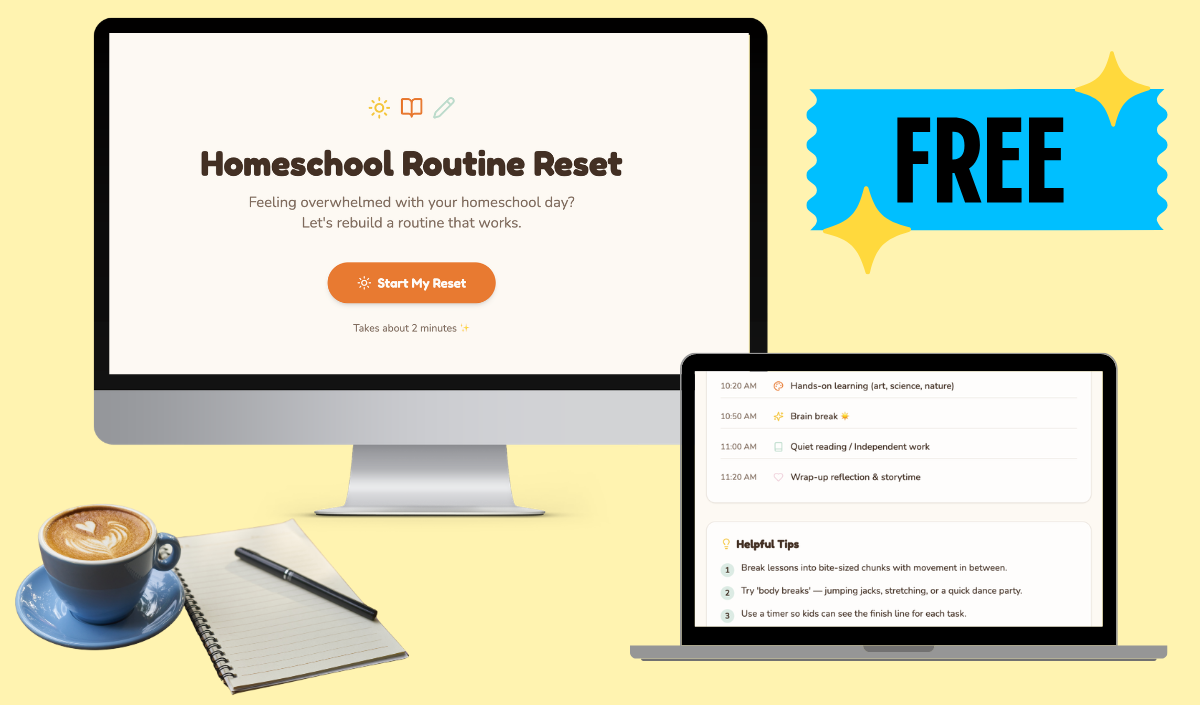
Why I Created Homeschool Routine Reset
I created Homeschool Routine Reset because so many families are trying to build homeschool routines while drowning in conflicting advice.
They don’t need more judgment. They need a starting point.
The app walks families through a few quick questions about:
their current homeschool struggles
what parts of the day feel hardest
support needs
routine challenges
Then it recommends a homeschool structure designed to feel more manageable and realistic for THEIR family.
Not a Pinterest family.
Not an “ideal” family.
Their actual family.
Because families deserve support that works in real life.
Final Reminder
If your homeschool routine has been feeling chaotic lately, this is your reminder:
You do not need a perfect system. You need a supportive one.
And you are not failing because your child needs flexibility, regulation support, or a different pace.
Many children learn best when they feel:
safe
supported
predictable
connected
regulated
That is not “doing homeschool wrong.” That is responsive parenting.
And honestly? That matters far more than a color-coded schedule ever will.
If you want help building a calmer homeschool rhythm, try Homeschool Routine Reset — a simple tool designed to help overwhelmed families create routines that actually fit real life.