Why Math Feels Overwhelming for Neurodivergent Learners and What Helps
“My Child Shuts Down Every Time We Start Math.”
“My child shuts down every time we start math.”
I hear some version of this from families all the time. The math book comes out, and suddenly your child puts their head down. They leave the table. They say, “I can't do this.” They stare at a problem they knew how to solve yesterday. Or they simply… stop.
When this happens, it's easy to focus on the lesson:
How do I get them to start?
Should I make them finish?
Are they avoiding the work?
Do I need a different curriculum?
But I want you to consider a different question:
What is making math hard to access right now?
That's the question at the heart of my Calm Over Chaos approach at Early Learning with Miss Kate.
Because when learning starts falling apart, my first response isn't:
How do we get through the worksheet?
It's:
What does this learner need in order to access what's being asked of them?
And that starts with regulation.
Regulation First. Always.
Regulation-first learning doesn't mean children have to be perfectly calm before they're allowed to learn. It doesn't mean removing every challenging task. And it definitely doesn't mean lowering expectations.
It means recognizing something pretty important: A child's ability to access a skill can look very different depending on what their nervous system is managing in that moment.
So when math suddenly feels impossible, I use a simple three-step framework:
READ THE ROOM → BUILD THE BRIDGE → OPEN THE DOOR
Let's walk through it.
Step 1: Read the Room
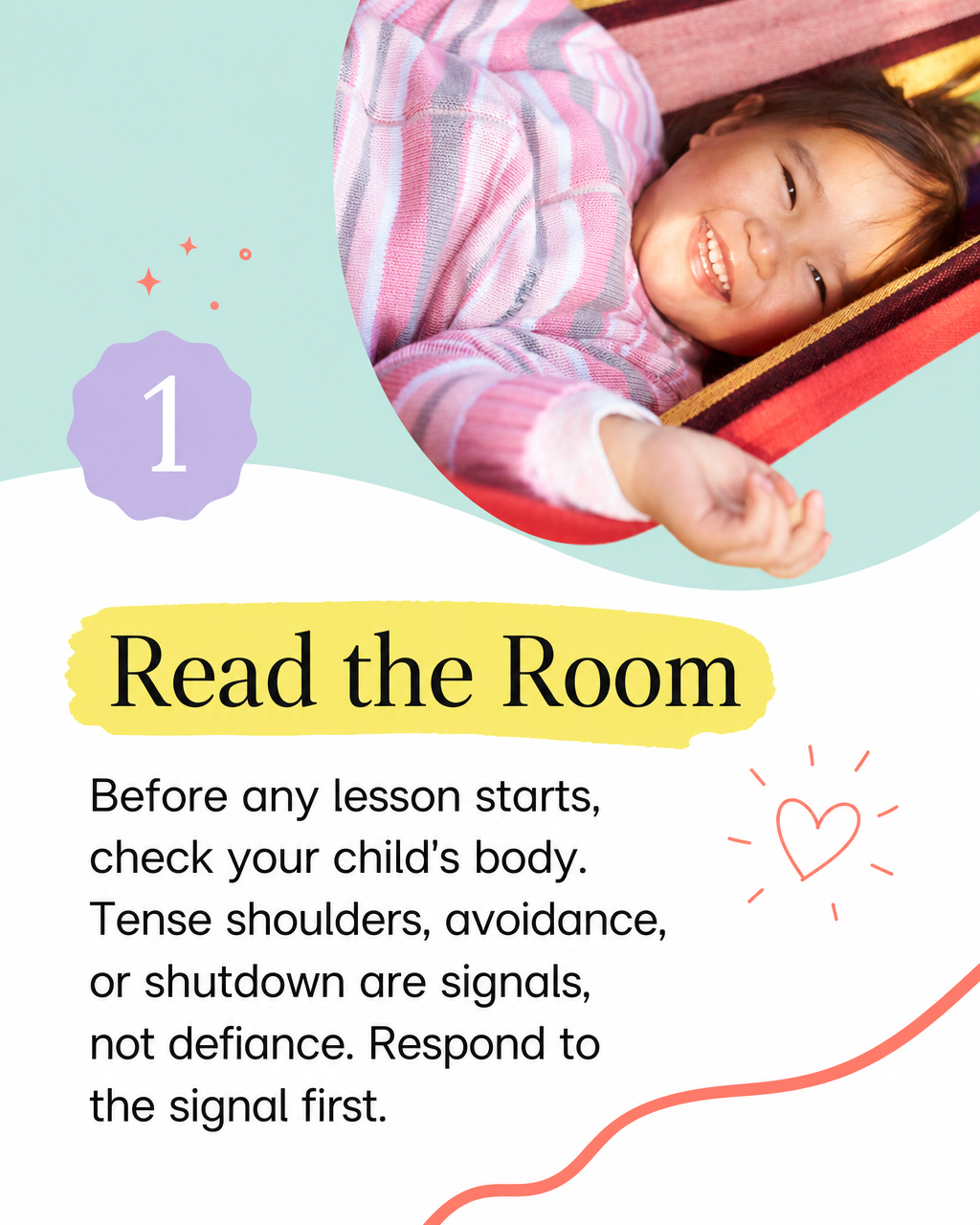
Before looking at the worksheet, look at your child. What are they communicating? Maybe you're seeing:
tense shoulders
looking away
putting their head down
getting unusually quiet
leaving the table
saying “I don't know” immediately
avoiding the materials
increased movement
frustration that seems to come out of nowhere
These aren't automatically signs that your child is being difficult, lazy, or refusing to learn. They're information.
Instead of immediately asking:
“How do I get them to do the math?”
Try:
“What might be making this hard to access right now?”
You don't have to perfectly decode every behavior. You're simply shifting from trying to stop the behavior to trying to understand the message. That's a very different starting point.
Step 2: Build the Bridge
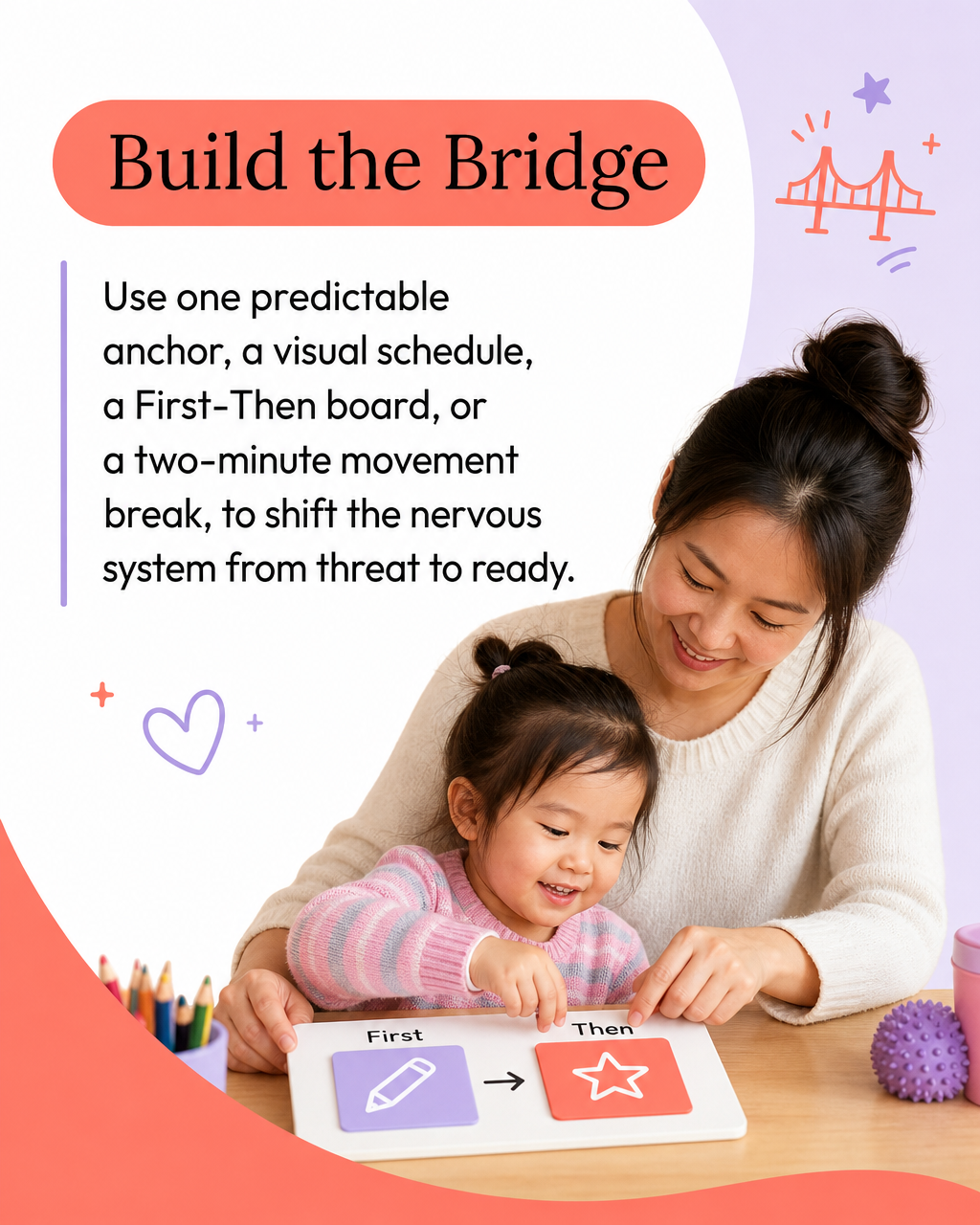
Now we need to help your child move from:
“This feels like too much.”
toward:
“Maybe I can do this.”
That's the bridge.
And it doesn't have to be complicated.
Add predictability.
A simple visual schedule might show:
Movement → Math → Snack → Outside
Now your child can see where math fits into the day and, importantly, what happens afterward.
Make the expectation visible.
Try a First-Then support:
FIRST: 3 math problems
THEN: Break
This isn't about making a child “earn” regulation. Breaks shouldn't only become available once a child has reached their limit. Instead, we're making both the expectation and the opportunity for rest predictable.
Add movement.
Maybe math doesn't need to begin in a chair.
Try two minutes of:
jumping
stretching
dancing
walking
pushing against a wall
carrying something
going outside
Then check in again.
Offer a little choice.
Not everything has to be optional for choice to matter.
Try:
“Do you want to use the whiteboard or paper?”
“Should we do this problem together or use the blocks?”
“Do you want to start with #2 or #4?”
Tiny choices can create meaningful access. The goal isn't compliance. The goal is participation.
Step 3: Open the Door
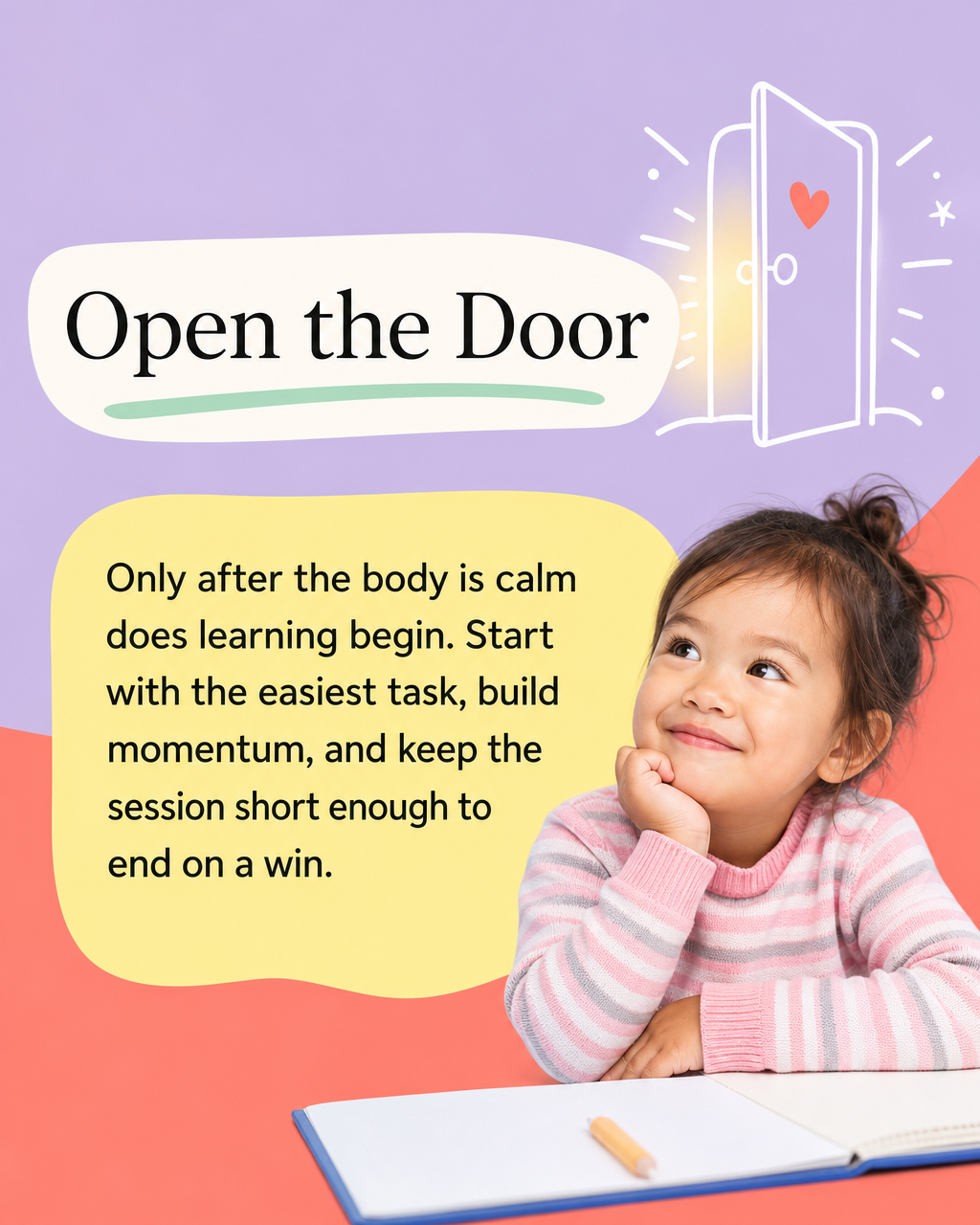
Once learning feels more accessible, don't immediately reach for the hardest problem. Start with success.
Find something your child already knows.
Do the first problem together.
Use manipulatives.
Let them answer verbally.
Draw it.
Use a whiteboard instead of a worksheet.
Start with three problems instead of twenty.
You're creating an entry point.
Because there's a big difference between beginning math with:
“I can't do this.”
and beginning with:
“Oh! I know this one.”
That first success can help open the door to everything that comes next.
You Don't Have to Finish the Page
This one can be hard. Especially when the curriculum says there are 20 problems. But the goal isn't to complete as many worksheets as possible. The goal is meaningful learning.
If your child has:
transitioned into the activity,
practiced the target skill,
participated successfully,
and reached the point where their capacity is changing… you can stop.
Five meaningful problems can be more valuable than twenty completed through escalating stress.
More work doesn't automatically mean more learning.
Sometimes ending successfully is part of the support.
If Math Shutdown Happens Every Day, Zoom Out
If this isn't an occasional hard day and math consistently leads to shutdown, it's time to become a detective.
Look for patterns.
When does it happen?
Is it when you announce math?
When the workbook appears?
When writing is required?
When your child sees a full page of problems?
When a particular skill comes up?
What happens before math?
Did your child just finish another demanding activity?
Are they transitioning away from something they love?
Are they hungry?
Tired?
Managing a lot of sensory input?
Does the format matter?
Try the same skill using:
manipulatives
a whiteboard
verbal answers
movement
games
fewer visible problems
larger print
hands-on materials
Does anything change?
Is the math itself the barrier?
Sometimes what looks like “math refusal” is actually:
writing is hard.
the page feels overwhelming.
the directions aren't clear.
the child doesn't understand one foundational skill.
the transition into math is difficult.
the task is too repetitive.
That's why I don't love stopping at:
“They don't want to do math.”
I want to know: What's getting between this learner and participation?
Because once we understand the barrier, we can start changing the support.
Regulation-First Doesn't Mean Lower Expectations
This is worth repeating.
Supporting regulation doesn't mean:
“They seem frustrated, so we'll never do math.”
It means:
“They're showing me that the current approach isn't accessible. What can we change?”
Maybe we change the environment.
Maybe we add a visual.
Maybe we offer movement.
Maybe we reduce how much is visible at once.
Maybe we change how the child responds.
Maybe we provide AAC or another communication support.
Maybe we build in a predictable break.
Maybe we simply start somewhere easier.
The learning goal can stay the same while the path to accessing it changes. That's support.
The Calm Over Chaos Reset
The next time a lesson starts falling apart before it even begins, remember:
1. READ THE ROOM
What is my child communicating?
Notice the signals before increasing the demand.
2. BUILD THE BRIDGE
What would make this feel more predictable or accessible?
Try a visual, movement, choice, a break, or another familiar support.
3. OPEN THE DOOR
What's the easiest successful entry point? Start there.
Build momentum.
Keep the learning meaningful.
And know when enough is enough.
The Goal Isn't a Perfect Math Lesson
Some days, the beautiful homeschool lesson you planned simply isn't going to happen. That's okay.
You can change the plan.
You can use the whiteboard instead of the worksheet.
You can do math on the floor.
You can take the movement break.
You can do five problems.
You can come back tomorrow.
Because we're not trying to create children who can push through anything adults put in front of them. We're helping children understand themselves, communicate what they need, access meaningful learning, and build skills with support.
That's what Calm Over Chaos means to me.
Less pressure.
More predictability.
More access.
More connection.
And yes, meaningful learning, too.
Want More Support for a Calmer Homeschool Day?
At Early Learning with Miss Kate, I share practical, strengths-based support for families of autistic and neurodivergent learners without trying to make children look, learn, communicate, or regulate like everyone else.
If you're looking for ways to make learning more accessible while still helping your child make meaningful academic progress, explore my autism-friendly resources, homeschool support, and tutoring options. You can also join my community by clicking here.
Let's build learning around the child — not force the child to fit the lesson. 💛